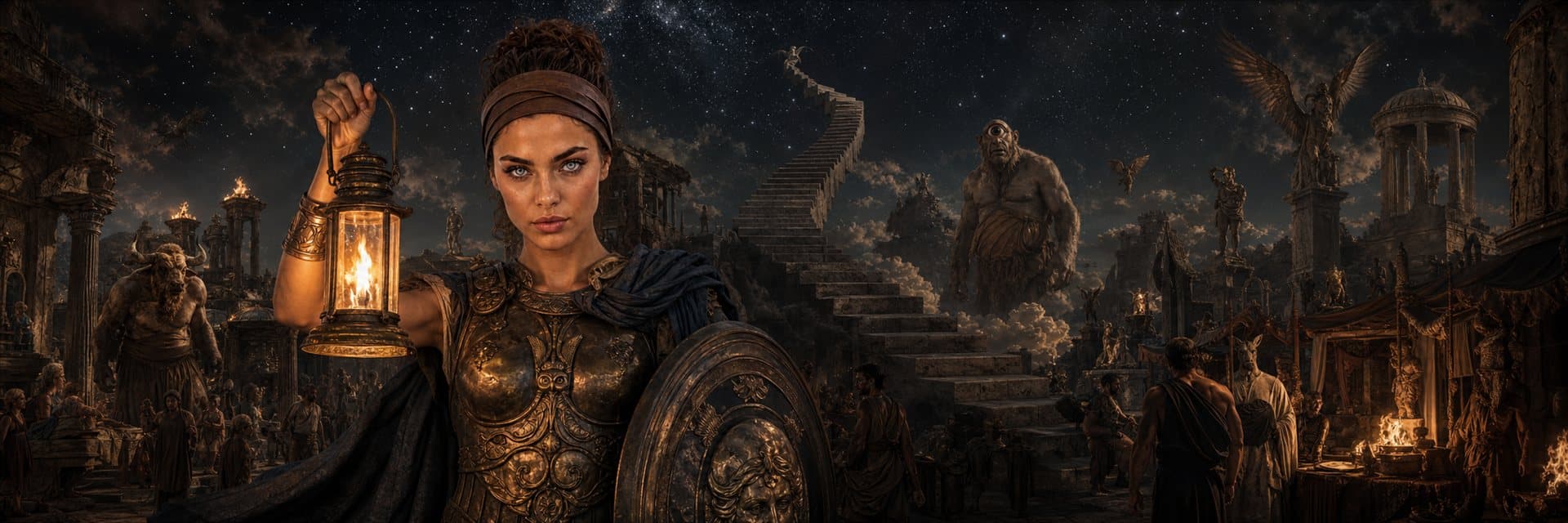
The Greeks called a dream an oneiros (ὄνειρος), and did not treat it as private mental noise. Homer and Hesiod personified dreams as the Oneiroi(Ὄνειροι), daimonic beings dwelling at the edge of the world near the house of Hypnos, god of Sleep, and his twin brother Thanatos, god of Death — dreams and death, in the Greek imagination, were siblings. A dream could be sent by Zeus or another god directly into a sleeper’s mind, a genuine visitation rather than an accident of the body.
Not every dream was trusted. In Book 19 of the Odyssey, Penelope tells Odysseus that dreams pass through one of two gates: true dreams, destined to come to pass, arrive through the Gate of Horn; false, deceptive dreams arrive through the Gate of Ivory. The dreamer’s task — then as now — was to discern which gate a given dream had come through.
Dreams were read both collectively and individually. Collectively, entire cities practiced enkoimesis (ἐγκοίμησις) — “temple sleep,” or dream incubation — sleeping inside a sacred sanctuary, most famously the Asclepieia (temples of Asclepius, god of healing) at Epidaurus, in the hope that the god himself would appear in a dream to heal or diagnose the sleeper. Individually, professional interpreters practiced oneiromancy (ὀνειρομαντεία), the art of dream divination. The most complete surviving record of this individual practice is the Oneirocritica (“The Interpretation of Dreams”), written in the 2nd century CE by Artemidorus of Daldis— a systematic catalogue of dream symbols notable for a genuinely modern insight: Artemidorus insisted a symbol’s true meaning depended on the dreamer’s own particular life, trade, and circumstances, not a single fixed universal key. The same dream meant something different for a sailor than for a merchant.
Carl Gustav Jung (1875–1961), the Swiss psychiatrist who founded analytical psychology, spent his life treating dreams the way the Greeks did — as meaningful, not arbitrary. His last work, “Man and His Symbols” (1964), written for general readers in the months before his death, lays out his central claim in plain language: dreams speak in the symbolic vocabulary of the unconscious, and that vocabulary can be learned. In his clinical practice, Jung rarely read a single dream in isolation — he followed a patient’s dreams as a series, watching for their compensatory function: the way a dream corrects or balances something one-sided in the dreamer’s conscious waking attitude. To enrich a symbol’s meaning, he used amplification — setting it beside its parallels in myth, religion, and alchemy across cultures, rather than assigning it one private, fixed meaning.
Long before “Man and His Symbols,” Jung had already lived this method on himself. Beginning around 1913, in a period he called his confrontation with the unconscious, he deliberately engaged waking visionary states — active imagination — and recorded them in his private journals, the Black Books, later reworked into the illuminated manuscript known as The Red Book (Liber Novus), unpublished until 2009. The archetypes, the collective unconscious, and the process of individuation that structure his later theory all grew out of that material.
The resemblance to ancient Greek practice is not superficial. Where the Greeks trusted the Oneiroi to carry something larger than the dreamer’s own mind, Jung trusted the collective unconscious. Where Artemidorus insisted a symbol’s meaning bent around the individual dreamer’s own life, Jung insisted amplification always return to the dreamer’s own personal context, never a generic dream-dictionary entry. That is why Athena reads primarily through Jung here — his is the most complete, best-documented framework for what a dream does psychologically — while still drawing, in the spirit of amplification itself, on the comparative symbol-traditions of Greece, and other spiritual and esoteric systems where they genuinely illuminate what you dreamed. Every reading stays general and well-established across those traditions rather than overreaching into anything invented.